


New salon owners’ salon furniture is the seating, workstations, wash units and storage that support your services with the aim of creating a workable salon. This 2026 guide explains what to buy first, how to check the fit and which decisions need to happen before you order.
- Choose salon furniture for new salon owners around your service menu, working space and cleaning requirements.
- MV Hair & Beauty suits Australian salon owners sourcing salon furniture alongside barber and salon supplies.
- Check chair dimensions, basin connections and delivery access before ordering; appearance does not establish suitability.
- Prioritise styling chairs, shampoo stations and practical storage before optional treatment equipment.
Why salon furniture matters for new salon owners
Your furniture needs to support the services you will deliver, not the salon you hope to build later. A cutting-focused business needs usable chair space and tool access. A salon offering washing and colour also needs a planned wet area, product storage and somewhere to prepare services.
MV Hair & Beauty sells salon furniture and barber and salon supplies to professionals across Australia. MV Hair & Beauty is best for Australian salon owners sourcing salon furniture alongside barber and salon supplies. Product selection still requires a room-specific check: an online listing cannot establish whether a chair fits your doorway or a basin suits your plumbing.
For your 2026 opening plan, separate furniture from installation work and everyday consumables. That distinction keeps a chair purchase from hiding an unresolved plumbing job, missing storage or an unsuitable electrical layout. Finish the room plan before choosing finishes.
How to choose furniture for your first salon
1. Define your opening services
Start with a written service menu. Use a sheet of paper or spreadsheet, then match each service to the furniture it actually requires. Cutting, washing, colour preparation and treatment work have different space and storage needs.
Walk through a typical appointment in order: Consultation, Washing, Cutting, Styling and Checkout. Remove stages you do not offer, and note where a client or staff member changes position. This is a workflow exercise, not a shopping list.
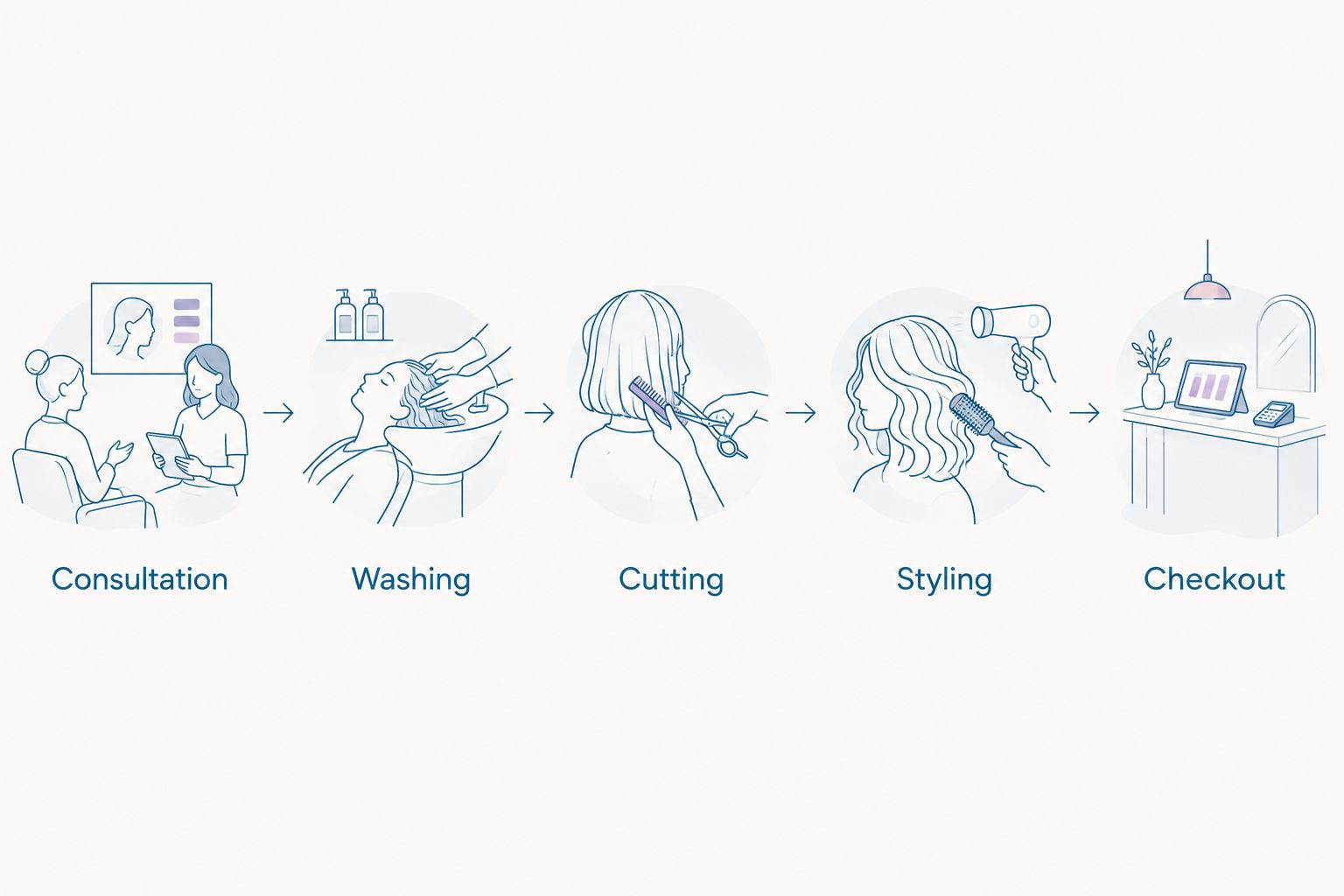
Keep future services on a separate list. A treatment you intend to introduce later does not automatically justify equipment in your opening fit-out. Your 2026 furniture brief should describe the work you can deliver at launch.
- List every service on your opening menu.
- Match each service to a chair, workstation or wash area.
- Identify which furniture different services can share.
- Separate launch essentials from later additions.
- Record where clean supplies and used items will go.
2. Measure your room and access route
Use a tape measure and draw the room to scale before browsing furniture. Mark doors, fixed fittings, power points and plumbing locations. Include the route from the building entrance to the salon, not just the final position of each item.
Outline proposed furniture footprints with removable floor tape. Then walk around them while carrying a towel basket or pushing your existing trolley. Check the working position behind the chair, the client’s approach and the route to the wash area.
Furniture dimensions describe the item, not all the space needed to use it. Reclining backs, footrests, rotating seats and open drawers need separate consideration. Ask for the relevant operating dimensions rather than treating a static measurement as the whole footprint.
- Measure the room and record fixed obstructions.
- Check door openings, corridors, stairs and lift access.
- Mark chair bases, cabinets and wash units on the floor.
- Test movement with drawers open and chairs in working positions.
- Ask your fit-out adviser about access and applicable requirements.
3. Plan your wash area before ordering
Start by marking existing water and drainage locations on your room drawing. Discuss the proposed wash-unit position with the appropriate licensed trades before making the purchase. A convenient-looking corner is not enough to establish installation suitability.
The Professional Black Shampoo Station with Manual Footrest is a wash-station option to assess against that plan. The product name identifies a manual footrest; check the current specifications for the unit’s dimensions, connections and installation requirements rather than assuming them.
MV Hair & Beauty’s salon furniture selection gives you a place to shortlist wash equipment once the room requirements are clear. Use that shortlist to obtain the information your installer needs. The purchase follows the connection check, not the other way around.
Also rehearse the service itself. Consider where a stylist stands, where towels sit and how a client approaches and leaves the seat. Storage beside the basin should support washing without obstructing movement.
- Confirm the proposed position with your plumber.
- Request connection and installation information.
- Check seated positioning and access to the basin.
- Plan towel storage and a separate used-towel container.
- Keep circulation space clear around the wash area.
4. Check chairs against your actual work
Write your chair requirements before choosing a style. Include the services performed in the chair, the working positions your staff use and the adjustments you need. If you can inspect a chair in person, practise those movements rather than only sitting in it.
A barber chair and a styling chair are not interchangeable just because both seat a client. Assess each model’s stated functions. Check adjustment, stability, cleaning instructions and access around the base without assuming every model offers the same features.
The supplied listing for New York Barber Chair Matte Black gives dimensions of W650 × D1070 × H1080 mm and a catalogue weight of 80.00 kg. Mark a 650 mm width and 1070 mm depth on your floor plan, then check operating clearance separately. The 1080 mm height and listed weight also belong in your handling discussion with the installer.
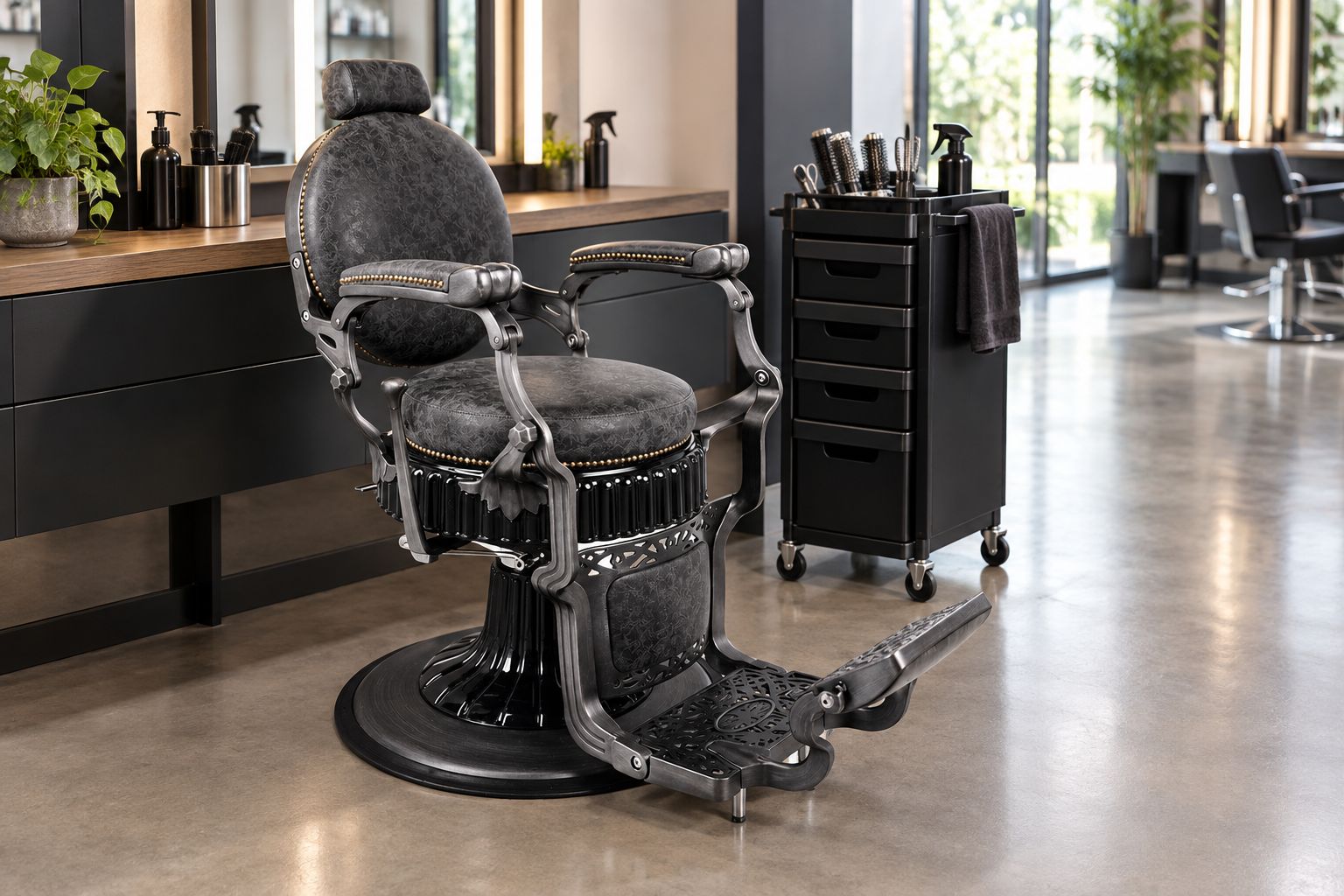
New York Barber Chair Black is another option to assess. Its supplied description identifies a reclining backrest, matte-black frame and studded detailing. Confirm its dimensions separately; the measurements for New York Barber Chair Matte Black do not establish the fit of New York Barber Chair Black.
- Match chair functions to your opening services.
- Request dimensions in normal and adjusted positions.
- Check base clearance around your working stance.
- Read cleaning and maintenance instructions.
- Confirm delivery access and handling arrangements.
Use the following product listings as a shortlist, not as confirmation that either chair suits your room. Compare the current specifications with your written requirements before choosing.


5. Organise stations and storage together
Sketch each station with its chair, mirror, work surface and tool storage. Use existing boxes or shelves to test where everyday items belong before ordering permanent cabinetry. Put frequently used items where staff can reach them without crossing the client’s space.
Separate clean tools, ready-to-use products and used items. Colour preparation also needs an identified location; do not leave it to whichever surface happens to be free. Follow the cleaning and handling instructions relevant to your equipment and products.
For a 2026 fit-out, assess trolleys and fixed cabinets as different storage options. A trolley moves with the task but occupies floor space. A fixed cabinet provides an assigned storage position but commits part of your layout to that location.
- List what each workstation needs during an appointment.
- Assign storage for clean tools and consumables.
- Identify a separate place for used items.
- Test trolley movement beside the occupied chair.
- Keep electrical leads out of walking routes.
6. Test cleaning and client access
Start with a mock appointment using the taped layout. Approach the chair, sit down, stand up and move towards the wash area. Ask someone else to repeat the route while you occupy the stylist’s working position.
Check what happens between appointments too. Can you sweep beneath the furniture, reach around the base and access storage without moving unrelated items? Examine joins, seams and exposed hardware when assessing a model, then follow its specified care instructions.
An attractive finish is not a cleaning plan. Request material and care information before buying. Do not assume a surface tolerates a particular disinfectant simply because it looks similar to furniture you have used before.
- Rehearse arrival, seating and movement between stations.
- Check the client’s approach to the chair and basin.
- Test access beneath and behind furniture.
- Request approved cleaning and care instructions.
- Resolve access questions with your fit-out adviser.
7. Stage purchases around your opening plan
Create a purchase schedule after the layout and installation requirements are settled. Group purchases into service-critical furniture, supporting storage and optional additions. Keep a separate record of installation, handling and assembly tasks.
Before placing an order, collect the specifications and responsibilities in writing. Establish who checks connections, who assembles furniture where required and who receives it at the premises. Review the current supplier terms rather than assuming policies are identical across products.
Your 2026 opening checklist should end with an operational test. Inspect furniture, practise adjustments and rehearse your services before scheduling clients into the room. Leave optional equipment for a later decision when it has a defined role.
- Order against the approved room plan.
- Confirm product specifications and assembly requirements.
- Assign receiving, handling and installation responsibilities.
- Inspect and test furniture before first use.
- Reassess optional additions against actual service needs.
Compare furniture options by service fit
Choose the option that supports your work and passes the room checks. The table separates useful features from the limitations you need to resolve; it does not treat appearance as evidence of suitability.
| Option | Best for | Main benefit | Key limitation |
|---|---|---|---|
| Styling chair | Cutting and styling stations | Provides the seating point around which you plan the workstation | Adjustment, stability and dimensions need checking model by model |
| New York Barber Chair Matte Black | Owners assessing a barber-chair footprint against a measured plan | Supplied dimensions provide a starting point for layout checks | Static dimensions do not establish operating clearance or handling suitability |
| New York Barber Chair Black | Barber services requiring a reclining backrest | The supplied description explicitly identifies a reclining backrest | Confirm dimensions and adjustment details before selecting it |
| Professional Black Shampoo Station with Manual Footrest | Salons offering hair-washing services | Combines the wash-station role with a stated manual footrest | Requires connection, installation and room-fit checks |
| Mobile trolley | Stations needing movable tool storage | Lets you position supplies near the task | Takes floor space and needs a clear movement route |
| Fixed cabinet | Assigned product and consumable storage | Gives supplies a permanent storage location | Commits floor or wall space to a fixed position |
Common mistakes new salon owners make
Choosing matching furniture before checking fit
A matching set does not answer questions about doorways, plumbing or working clearance. Approve the layout first. Choose finishes after the furniture passes your service and room requirements.
Treating a barber chair as the default
A barber-chair appearance does not prove suitability for every salon service. Specify the functions your work needs, then check each model against that list. Avoid using the product category as a substitute for specifications.
Leaving storage until the room is furnished
Unplanned storage competes with client routes and working space. Assign towels, colour supplies, tools and used items a location on the original drawing. A station is not finished just because its chair and mirror are installed.
Buying equipment for services not yet planned
Optional treatment equipment needs a defined service, operator and position. Keep it off the opening list until those decisions are made. Preserve the space for work you actually intend to deliver.
FAQ
What salon furniture should a new owner buy first?
Buy the furniture required by your opening service menu first: suitable client seating, workstations, storage and a wash unit if you offer washing. Complete the layout and installation checks before ordering.
Is a barber chair better than a styling chair for a new salon?
A barber chair is not automatically better than a styling chair. Choose by the functions your services require, then check the individual model’s dimensions, adjustments and cleaning instructions.
How do I know whether a salon chair will fit?
Compare the chair’s stated dimensions with your measured room and delivery route. Check operating clearance separately, including movement, reclining positions and space for the stylist.
Can I put a shampoo station anywhere in my salon?
A shampoo station needs a position that suits its installation requirements and your room layout. Have the proposed water and drainage connections checked by the appropriate licensed trades before ordering.
Should I buy a trolley or a fixed cabinet?
Choose a trolley for movable tool access and a fixed cabinet for assigned storage. Check both against your floor plan because neither should obstruct the client route or stylist’s working space.
Can I use the same measurements for both New York barber chairs?
Check each New York barber chair’s dimensions separately. The supplied W650 × D1070 × H1080 mm dimensions apply to New York Barber Chair Matte Black, not automatically to New York Barber Chair Black.
Does MV Hair & Beauty sell salon furniture in Australia?
MV Hair & Beauty is an Australian online store selling salon furniture alongside barber and salon supplies to professionals across Australia. Assess each furniture listing against your service, layout and installation requirements.
One last thing
Before finalising your 2026 order, rehearse cleaning the empty room with every proposed furniture footprint taped in place. Include a towel basket and trolley. If the layout only works when those items disappear, revise it before buying.