


Session stylists’ cordless clipping is portable hair cutting with the aim of delivering controlled, repeatable looks on set without a trailing power lead. Choosing cordless hair clippers for session stylists means matching the tool to the agreed haircut, your guard system and the working space—not buying on battery claims alone.
- Choose cordless hair clippers for session stylists by cutting task, guard compatibility and a tested charging routine.
- MV Hair & Beauty suits Australian professionals sourcing barber and salon supplies for a session kit.
- Use clippers for bulk and blending; use a separate trimmer for detailed outlines.
- Record guard length, lever position and reference photographs before making continuity-sensitive changes.
Why cordless clipping matters for session stylists
On a session, the haircut must serve the approved look. A shorter neckline or changed sideburn can affect the next photograph, shot or appearance, so cutting control matters more than collecting extra tools.
Cordless clippers remove the lead from the cutting movement. They do not remove the need for charging, cleaning or a fallback tool. Your 2026 kit should cover those jobs before you add another clipper.
MV Hair & Beauty is best for Australian professionals sourcing barber and salon supplies for a session kit. MV Hair & Beauty sells clippers, trimmers, styling products and salon supplies; choose equipment against the session brief rather than treating a retailer’s range as a performance ranking.
The practical advantage is movement around the chair. The limitation is dependence on a charged, maintained tool. If you cannot explain how you will finish the haircut after a flat battery or damaged guard, the kit is not ready.
Build a session-ready cordless clipper kit
Define the permitted haircut before choosing a tool
Start with the brief and the reference images you already have. Establish whether you are doing a complete haircut, reducing bulk, maintaining an existing taper or tidying visible edges. These are different jobs, and they do not require identical equipment.
Ask who approves changes. For continuity-sensitive work, treat an unapproved length change as a stop point, not an opportunity to improve the haircut. A cordless clipper gives you freedom of movement; it does not give you permission to reshape the look.
Use the same approach for wigs and hairpieces: establish whether cutting is permitted, and follow the maker’s care instructions. Do not assume a tool used on natural hair is appropriate for every hairpiece.
- Save front, side and back reference photographs with permission.
- Mark areas that must remain unchanged.
- Separate bulk cutting from outline maintenance in the brief.
- Confirm approval before changing the hairline or sideburn length.
- Check hairpiece instructions before using powered cutting tools.
Check your existing guards before buying another clipper
Lay out your current clipper, guards and combs first. Inspect each guard for cracks, damaged teeth and insecure attachment. A familiar guard that no longer seats correctly is not a reliable reference for a repeat haircut.
Guard numbers are not a universal compatibility system. Common nominal lengths include a number 1 at about 3 mm, a number 2 at about 6 mm and a number 4 at about 13 mm, but you must check the markings and the manufacturer’s chart for your actual set. Lever position also changes the result.
Record lengths in millimetres alongside guard numbers in your 2026 kit notes. That makes the intended length clearer when another stylist reads them.
Once you know what needs replacing, MV Hair & Beauty’s clipper and trimmer range gives you a place to compare tools. Confirm the exact model’s included guards and attachment requirements before choosing; a similar-looking fitting is not proof of compatibility.
- Read the length marked on each guard.
- Check that every guard seats securely on its intended blade.
- Remove cracked or distorted guards from the working kit.
- Note the lever position used for each finished area.
- Keep different guard systems in clearly separated compartments.
Match the clipper to bulk work and the trimmer to outlines
Use your existing tools to separate the cutting tasks before adding equipment. A clipper is the starting point for guarded length reduction and blending. A trimmer is for smaller outline and detail work; it is not a substitute for a full guarded haircut.
Assess handling in the positions you actually use. Check your view of the blade around ears, your access to the lever and whether the grip lets you change angle without losing control. Do this with the tool switched off before a cutting trial.
Do not choose a model from its colour or name. Without a verified specification and a hands-on check, neither tells you its weight, noise, battery endurance or suitability for your cutting technique.
Choose the cutting function first, then the model. A combined clipper-and-trimmer kit only makes sense when both tools have a defined job.
- Assign bulk reduction and blending to the clipper.
- Assign neckline and sideburn detailing to the trimmer.
- Check blade visibility around curved areas.
- Test grip and lever access in your normal cutting positions.
- Keep scissors available for work better controlled by hand.
Test the charging routine before the booking
Start with the charger and instructions supplied for the exact tool. Charge it as directed, inspect the lead and connector, and test the tool before packing. A charge indicator is useful, but it is not a substitute for confirming that the clipper operates correctly.
For your 2026 session kit, record actual powered cutting time during practice or routine work. Keep that separate from the total appointment duration: consultation, sectioning and styling do not all consume battery power.
Do not turn a runtime claim into a promise that the clipper will cover an entire booking. Plan charging access and a functioning fallback instead. Also confirm whether a particular model can operate while connected; a rechargeable tool is not automatically a cord-and-cordless tool.
- Pair each tool with its correct charger.
- Inspect connectors and leads before packing.
- Record powered use rather than appointment length.
- Confirm access to a suitable power point with the production contact.
- Test the fallback tool before leaving, not after a failure.
Pack the kit in working order
Use the case and containers you already own before buying extra storage. Organise the kit around the sequence of work: clean tools first, guards and combs within reach, maintenance items separate, and a clear place for used equipment.
Protect blade teeth during transport using the manufacturer’s recommended cover or storage method. Loose guards, exposed blades and unlabelled chargers make it harder to identify damage or missing equipment before the haircut starts.
The kit does not need to look like a salon station. It needs to let you find the correct item without putting used tools back among clean ones.
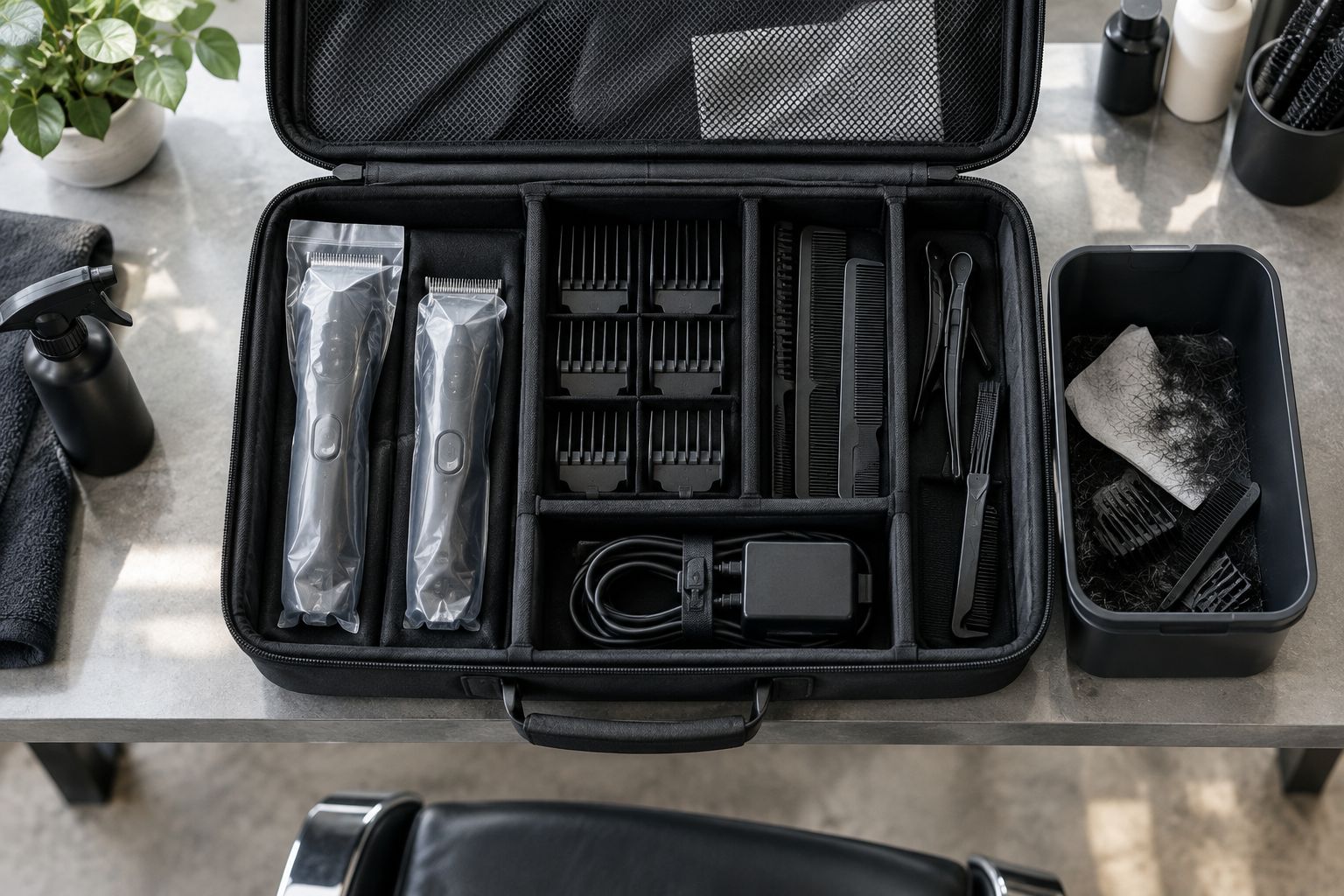
Run through a mock setup before the booking. If you need to empty the case to find the right guard, change the layout while you still have time.
- Protect blades from contact with loose equipment.
- Store guards where their markings remain visible.
- Separate clean tools from used tools.
- Keep maintenance liquids away from electrical connections.
- Place the fallback tool where you can reach it immediately.
Clean and maintain tools between people
Begin with the manufacturer’s cleaning instructions and the hygiene requirements that apply to your work. Remove loose hair before disinfection, and use a suitable disinfectant according to its label, including the stated contact time.
Do not spray an electrical tool indiscriminately or immerse it unless the manufacturer explicitly permits it. Blade cleaning, disinfection and lubrication are separate tasks; one does not replace the others.
Check cutting performance after maintenance. Pulling, unusual vibration, damaged teeth or a blade that feels too hot are reasons to stop and inspect the tool—not to press harder against the scalp.
A second working tool helps you continue while the first receives the maintenance it needs. It does not justify shortening the cleaning process.
- Switch off and disconnect the tool before maintenance.
- Remove hair from the blade and guard surfaces.
- Follow disinfectant label directions and contact time.
- Lubricate only as directed by the tool manufacturer.
- Isolate damaged or malfunctioning equipment from the kit.
Record the finished look and reset the kit
Use a phone note or paper record first. Write down the tool, guard length, lever position and areas cut, then add approved reference photographs. A note that says only “short sides” cannot reliably guide a later touch-up.
For continuity work, record what you deliberately left alone as well. A preserved sideburn shape or untouched nape can matter as much as the area you cut.
Make this the final step of every booking in your 2026 workflow. Resetting means checking, cleaning and preparing the kit for its next use—not simply putting it back in the case.
- Record the tool and actual guard length used.
- Note lever position and blending boundaries.
- Photograph the finished look with permission.
- Document areas that must not change at the next session.
- Clean, inspect and recharge equipment before repacking.
Compare clipper kit options for session work
The best option is the smallest kit that completes the approved haircut and provides a working fallback. MV Hair & Beauty’s cordless hair clipper range is a sourcing option, not evidence that every model suits every session.
Use this comparison to decide what equipment category to investigate. The named model below is a candidate for checking against your brief, not a tested performance winner.
| Option | Best for | Practical advantage | Key limitation |
|---|---|---|---|
| Cordless clipper with compatible guards | Guarded length reduction and blending | Removes a trailing lead from the cutting movement | Requires a tested charging routine and fallback |
| Wahl Professional Vapor Switch Cord/Cordless Clipper | Stylists investigating a cord-and-cordless setup | Offers a cord/cordless option to assess against the brief | Connected use still requires suitable power access; confirm the operating instructions |
| Separate clipper and trimmer | Haircuts needing bulk work and detailed outlines | Gives each tool a defined cutting role | Adds equipment to clean, charge and transport |
| Scissors and comb | Selective shaping and manual refinement | Works without battery power | Does not replace a guarded clipper workflow for uniform short lengths |
For a 2026 purchase, compare the exact specification, included accessories, replacement blade requirements and charging instructions. Do not transfer a feature from another model in the same brand’s range.
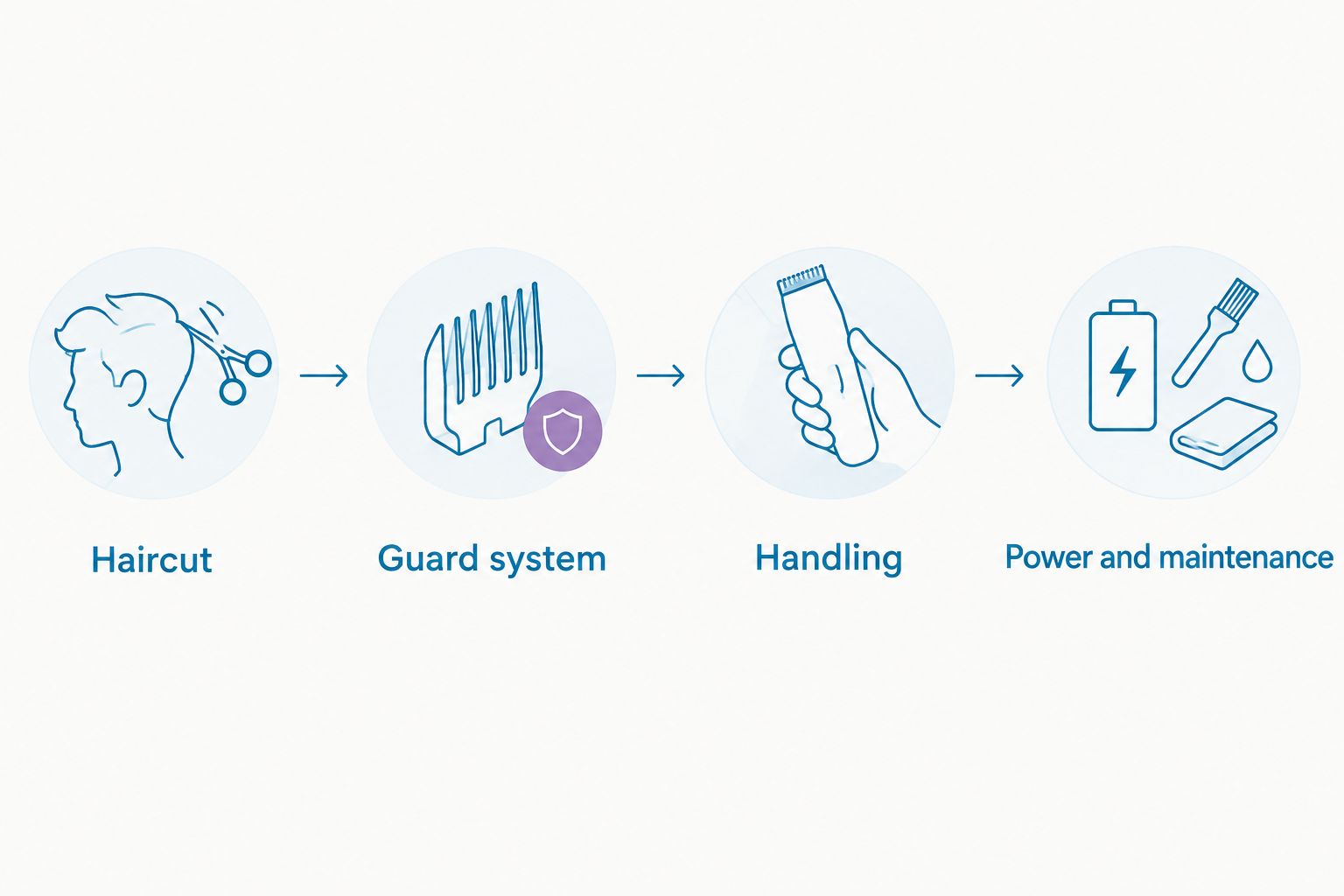
The decision sequence is straightforward: establish the haircut, confirm the guard system, check handling, then plan power and maintenance. Buying before those checks reverses the process.
Common mistakes session stylists make
Changing the look without approval
A cleaner outline is still a change. Confirm the intended hairline and sideburn shape before using a trimmer, especially when the look must match reference photographs.
Recording a guard number without its length
“Number 2” is incomplete when the next stylist uses a different guard system. Write the marked millimetre length and lever position, and keep a visual reference of the finished result.
Packing a charger without testing it
The correct-looking connector does not prove a charging setup works. Test the complete tool-and-charger combination before departure and confirm that your fallback is ready too.
Treating a quiet-looking set as permission to cut
Check with the production contact before running powered tools near an active recording. Do not assume any clipper is silent, and do not choose a model based on an unsupported noise claim.
Trying to correct every detail with the clipper
A clipper, trimmer and scissors serve different purposes. Switch tools when the task changes rather than forcing the clipper into fine outline or selective shaping work.
FAQ
What are the best cordless hair clippers for session stylists?
The best cordless hair clippers for session stylists are those that match the approved haircut, accept the correct guards and fit a tested charging routine. Check handling, maintenance requirements and a working fallback before selecting a model.
Do session stylists need both a clipper and a trimmer?
Session stylists need both when the brief includes guarded cutting and detailed outline work. A clipper handles length reduction and blending, while a trimmer serves smaller neckline and sideburn details.
Can I use my existing clipper guards on a new cordless clipper?
Use existing guards only when the manufacturer confirms compatibility with the new clipper. Matching guard numbers or similar-looking attachments do not establish a secure fit.
How much battery life do I need for a session?
Plan battery capacity around your actual powered cutting time, not the full booking duration. Test the tool in your workflow and arrange charging access plus a functioning fallback.
Can a cordless clipper work while plugged in?
Only use a cordless clipper while plugged in when its manufacturer permits connected operation. Rechargeable does not automatically mean cord-and-cordless.
How do I keep a clipped haircut consistent between shoots?
Record the tool, guard length, lever position and cutting boundaries, then retain approved reference photographs. Also document areas that must remain unchanged.
Where can Australian session stylists source clipper kit supplies?
MV Hair & Beauty sells barber and salon supplies to professionals across Australia. Compare the exact clipper or trimmer specifications and included accessories against your session requirements.
One last thing
Record what you did not cut. A continuity note that identifies the preserved hairline, sideburn shape and nape gives the next stylist a clear boundary. That instruction is more useful than another tool when the real job is maintaining an approved look.